
Showing posts with label Walter Tetley. Show all posts
Showing posts with label Walter Tetley. Show all posts
Friday, January 30, 2015

Sunday, November 10, 2013

Tuesday, May 29, 2012


Friday, September 30, 2011
Friday, August 5, 2011
And now for something completely different!
On March 28, 1944, Jim Jordan got a bad case of pneumonia, was put into the hospital and he and Marian missed an episode of their own show.
So instead of Fibber and Molly in their comfortable positions as door-answerers and joke throwers, substitutes Harold Peary and Walter Tetley took their place.
That sounds like it should work out perfectly. After all, Peary had a spin-off show of his own from Fibber McGee and Molly at the time (Great Gildersleeve) and was familiar with writer Don Quinn, commercial spokesman Harlow Wilcox and two of Fibber's co-stars were also co-stars on the Great Gildersleeve (Shirley Mitchell and Arthur Q. Bryan.)
This is one very interesting episode and I thought I would provide you with a written commentary of the audio. So off we go...
An interesting start. It's not unusual to hear Gildersleeve in this surrounding but it is indeed strange to hear Tetley's voice in Wistful Vista...
In case you haven't realized it, this is the first - and I believe only - time "we" are on the front porch of the McGee home knocking on the door. Every other episode is about the McGees being inside their home with people coming to the door. So in the mind's eye, you can actually visualize walking up the steps and ringing the doorbell.
And Beulah (played by Marlin Hurt - yes, a white man) did a fantastic job in this episode as he got more lines than usual.
Hurt got his own show not too long after this episode but died suddenly of a heat attack in 1949.
And speaking of dying...
This Gildersleeve joke didn't go anywhere. It's a fine joke and it isn't hard to see that it's a Don Quinn line. Perhaps it's all in the delivery. If Fibber said it, it would have been funny....
I'm sure Birdie's full name was mentioned on the Great Gildersleeve show but I certainly don't remember it. "Birdie Lee Coggins" will be stored away now for trivia purposes.
How is it though that Birdie and Beulah happen to know each other when Summerfield and Wistful Vista are so far apart? We'll never know.
To my knowledge, this is the only time "she" changes her classic catchphrase. She says, "Love that boy!" about Leroy.
Peary flubs his line. He probably didn't have much time to go over the script seeing how Jim Jordan was ill.
The above sounds more like a part of a script on the Great Gildersleeve program as Leroy needles his Unk.
Another case of Peary bumbling through his lines! I don't fault Peary, mind you, as I'm sure he had little time to prepare. Notice though, how fluently Tetley reads his lines throughout the show.
A funny hall closet routine!
Leroy says, "For corn's sake" - which was one of his many catchphrases he used on the Great Gildersleeve program and which Ben Ohmart and Charles Stumpf later would use as the title for their book about Tetley:

Also a Brownie camera is mentioned. For those who don't know, this is what they look like:

And according to Wikipedia, synthetic rubber of one kind or another has been around his 1879.
Sigmund Wellington shows up at the door. Gildersleeve seems to know him but Wellington didn't become a character until 1943, long after Peary had left the show. (Ransom Sherman played Wellington as well as other characters, including the voice of Molly's Uncle Dennis.)
Wellington mentions a Madame Curie movie poster:

Gildersleeve finds Fibber's mandolin and plays and sings, "Pretty Red Wing" - which is the exact same song Fibber tried to play and sing with the mandolin the episode of Fibber McGee and Molly a week prior to this one!
A nicer version:
Intentional or unintential, Peary is able to slip in his sponsor Kraft into the conversation of Harlow Wilcox...
Even Harlow gets a case of the flubs...
Doc Gamble (Bryan) stops by. Again, Gildersleeve and the Doc seem like old friends when in fact Doc Gamble didn't start on the show until 1943, when Gale Gordon went into the Coast Guard.
As a matter of fact, before Peary became Gildersleeve and played only bit parts on Fibber McGee and Molly, he played a doctor on two seprate occasions, one of them named "Doctor Gildersleeve."
Bryan played "Floyd" the barber on the Great Gildersleeve.
After the song, we get to hear from Alice Darling (Shirley Mitchell), the war worker who is a boarder in the McGee household. She of course plays Leila Ransom on the Gildersleeve program, his almost-always love interest. Other than the pun with her last name, there are no jokes about her being his love interest on the Gildersleeve show, which is quite surprising.
The show's ending is quite satisfying.
A fun show, wouldn't you say?
If you liked this commentary and would like to see more like this, it would be nice if you would let me know by comment or an email. I could do this in the future during lean times.
©Jimbo 2010/2011
So instead of Fibber and Molly in their comfortable positions as door-answerers and joke throwers, substitutes Harold Peary and Walter Tetley took their place.
That sounds like it should work out perfectly. After all, Peary had a spin-off show of his own from Fibber McGee and Molly at the time (Great Gildersleeve) and was familiar with writer Don Quinn, commercial spokesman Harlow Wilcox and two of Fibber's co-stars were also co-stars on the Great Gildersleeve (Shirley Mitchell and Arthur Q. Bryan.)
This is one very interesting episode and I thought I would provide you with a written commentary of the audio. So off we go...
An interesting start. It's not unusual to hear Gildersleeve in this surrounding but it is indeed strange to hear Tetley's voice in Wistful Vista...
In case you haven't realized it, this is the first - and I believe only - time "we" are on the front porch of the McGee home knocking on the door. Every other episode is about the McGees being inside their home with people coming to the door. So in the mind's eye, you can actually visualize walking up the steps and ringing the doorbell.
And Beulah (played by Marlin Hurt - yes, a white man) did a fantastic job in this episode as he got more lines than usual.
Hurt got his own show not too long after this episode but died suddenly of a heat attack in 1949.
And speaking of dying...
This Gildersleeve joke didn't go anywhere. It's a fine joke and it isn't hard to see that it's a Don Quinn line. Perhaps it's all in the delivery. If Fibber said it, it would have been funny....
I'm sure Birdie's full name was mentioned on the Great Gildersleeve show but I certainly don't remember it. "Birdie Lee Coggins" will be stored away now for trivia purposes.
How is it though that Birdie and Beulah happen to know each other when Summerfield and Wistful Vista are so far apart? We'll never know.
To my knowledge, this is the only time "she" changes her classic catchphrase. She says, "Love that boy!" about Leroy.
Peary flubs his line. He probably didn't have much time to go over the script seeing how Jim Jordan was ill.
The above sounds more like a part of a script on the Great Gildersleeve program as Leroy needles his Unk.
Another case of Peary bumbling through his lines! I don't fault Peary, mind you, as I'm sure he had little time to prepare. Notice though, how fluently Tetley reads his lines throughout the show.
A funny hall closet routine!
Leroy says, "For corn's sake" - which was one of his many catchphrases he used on the Great Gildersleeve program and which Ben Ohmart and Charles Stumpf later would use as the title for their book about Tetley:

Also a Brownie camera is mentioned. For those who don't know, this is what they look like:

And according to Wikipedia, synthetic rubber of one kind or another has been around his 1879.
Sigmund Wellington shows up at the door. Gildersleeve seems to know him but Wellington didn't become a character until 1943, long after Peary had left the show. (Ransom Sherman played Wellington as well as other characters, including the voice of Molly's Uncle Dennis.)
Wellington mentions a Madame Curie movie poster:

Gildersleeve finds Fibber's mandolin and plays and sings, "Pretty Red Wing" - which is the exact same song Fibber tried to play and sing with the mandolin the episode of Fibber McGee and Molly a week prior to this one!
A nicer version:
Intentional or unintential, Peary is able to slip in his sponsor Kraft into the conversation of Harlow Wilcox...
Even Harlow gets a case of the flubs...
Doc Gamble (Bryan) stops by. Again, Gildersleeve and the Doc seem like old friends when in fact Doc Gamble didn't start on the show until 1943, when Gale Gordon went into the Coast Guard.
As a matter of fact, before Peary became Gildersleeve and played only bit parts on Fibber McGee and Molly, he played a doctor on two seprate occasions, one of them named "Doctor Gildersleeve."
Bryan played "Floyd" the barber on the Great Gildersleeve.
After the song, we get to hear from Alice Darling (Shirley Mitchell), the war worker who is a boarder in the McGee household. She of course plays Leila Ransom on the Gildersleeve program, his almost-always love interest. Other than the pun with her last name, there are no jokes about her being his love interest on the Gildersleeve show, which is quite surprising.
The show's ending is quite satisfying.
A fun show, wouldn't you say?
If you liked this commentary and would like to see more like this, it would be nice if you would let me know by comment or an email. I could do this in the future during lean times.
©Jimbo 2010/2011
Saturday, July 30, 2011
Ten supporting characters who were superb
10. Emmy Lou - The Adventures of Ozzie and Harriet
Emmy Lou was played by Janet Waldo (who was also the star of Corliss Archer.) She did such an excellent job of playing a tiny part - that I simply had to mention her.
She played a bobby-soxer teen who seemed to have a crush on Ozzie and would often wail, "Ewwwwwwwwwwww!" - but in a nice, giddy way, not the "bad sour cream" way.
9. Raymond Johnson - Inner Sanctum
Raymond was the host of Inner Sanctum but was just as much a part of the show as the actors himself.
His humor was pure corn but it was delivered in such a way that remains memorable even if you have listened to the show just once.
8. Old Timer - Fibber McGee and Molly
Bill Thompson (who played several parts on Fibber McGee and Molly) made the Old Timer such a phenomenal character that his expression, "But that ain't the way I heerd it." became a national catch phrase during the second World War.
A near-deaf fellow with a propensity for telling jokes and ribbing Fibber week after week, put him on this list.
7. Chester Proudfoot - Gunsmoke
Chester (Parley Baer) seemed to fit in so seemlessly into Gunsmoke that he hardly seems to be there at all sometimes. But he was there - and this why he's on the list.
6. Miss Duffy - Duffy's Tavern
There were lots of Miss Duffys... but only one really stands out to me. As I wrote the other day: I really like the acting of Sandra Gould. Who's she, you ask? She played Miss Duffy on Duffy's Tavern from 1944-48; you may know her better as "the 2nd Gladys Kravitz" on the TV show, Bewitched. To me, she is perfect for the part of Miss Duffy.
Her accent seemed perfect and she delivered her lines flawlessly week after week.
If not for some stiff competition, she would rank even higher on this list.
5. Rush - Vic and Sade
Bill Idelson (who later became a writer for television) wasn't the star but by George, his performances easily stand out over the length and breadth of the entire series.
4. Perry White - The Adventures of Superman
Julian Noa created the character of Perry White and made him real. The character he created was later added into the comics and the various motion pictures and television for the Superman franchise.
While White wasn't on but perhaps a fifth or less of the radio shows, the character was done with such uniqueness that he remains the stereotypical newspaper editor.
3, Dr. Watson - The Adventures of Sherlock Holmes
The episodes that Nigel Bruce took on the role of Watson were so good that when Basil Rathbone (the "preferred" Holmes) left and John Conway took over that role, the show really never seems to skip a beat because Bruce was the anchor in which the show remained steady.
2. Gillis/Digby O'Dell - The Life of Riley
John Brown played both characters and played them so well and so differently that the uninformed would never know they were the same person.
Each character was so completely different and played such a vital part in the show that Brown probably deserves special recognition.
1. Leroy - Great Gildersleeve
Walter Tetley's role of Leroy is superior to all other supporting character roles on radio to me. Not only was he a very good actor - he was very funny. His delivery was second-to-none (aside from the likes of Orson Welles and Helen Hayes.)
©Jimbo 2010/2011
Emmy Lou was played by Janet Waldo (who was also the star of Corliss Archer.) She did such an excellent job of playing a tiny part - that I simply had to mention her.
She played a bobby-soxer teen who seemed to have a crush on Ozzie and would often wail, "Ewwwwwwwwwwww!" - but in a nice, giddy way, not the "bad sour cream" way.
9. Raymond Johnson - Inner Sanctum
Raymond was the host of Inner Sanctum but was just as much a part of the show as the actors himself.
His humor was pure corn but it was delivered in such a way that remains memorable even if you have listened to the show just once.
8. Old Timer - Fibber McGee and Molly
Bill Thompson (who played several parts on Fibber McGee and Molly) made the Old Timer such a phenomenal character that his expression, "But that ain't the way I heerd it." became a national catch phrase during the second World War.
A near-deaf fellow with a propensity for telling jokes and ribbing Fibber week after week, put him on this list.
7. Chester Proudfoot - Gunsmoke
Chester (Parley Baer) seemed to fit in so seemlessly into Gunsmoke that he hardly seems to be there at all sometimes. But he was there - and this why he's on the list.
6. Miss Duffy - Duffy's Tavern
There were lots of Miss Duffys... but only one really stands out to me. As I wrote the other day: I really like the acting of Sandra Gould. Who's she, you ask? She played Miss Duffy on Duffy's Tavern from 1944-48; you may know her better as "the 2nd Gladys Kravitz" on the TV show, Bewitched. To me, she is perfect for the part of Miss Duffy.
Her accent seemed perfect and she delivered her lines flawlessly week after week.
If not for some stiff competition, she would rank even higher on this list.
5. Rush - Vic and Sade
Bill Idelson (who later became a writer for television) wasn't the star but by George, his performances easily stand out over the length and breadth of the entire series.
4. Perry White - The Adventures of Superman
Julian Noa created the character of Perry White and made him real. The character he created was later added into the comics and the various motion pictures and television for the Superman franchise.
While White wasn't on but perhaps a fifth or less of the radio shows, the character was done with such uniqueness that he remains the stereotypical newspaper editor.
3, Dr. Watson - The Adventures of Sherlock Holmes
The episodes that Nigel Bruce took on the role of Watson were so good that when Basil Rathbone (the "preferred" Holmes) left and John Conway took over that role, the show really never seems to skip a beat because Bruce was the anchor in which the show remained steady.
2. Gillis/Digby O'Dell - The Life of Riley
John Brown played both characters and played them so well and so differently that the uninformed would never know they were the same person.
Each character was so completely different and played such a vital part in the show that Brown probably deserves special recognition.
1. Leroy - Great Gildersleeve
Walter Tetley's role of Leroy is superior to all other supporting character roles on radio to me. Not only was he a very good actor - he was very funny. His delivery was second-to-none (aside from the likes of Orson Welles and Helen Hayes.)
©Jimbo 2010/2011
Friday, July 22, 2011

Tuesday, July 12, 2011
Review - Honest Harold (The Harold Peary Show)
Imagine The Great Gildersleeve show. Now imagine taking away all the characters on the show besides Gildy and replacing them with ones of inferior talent. If you can successfully do both, you'll have a 'vision" of the 1950's radio program called, "Honest Harold."
The show is situated very much like The Great Gildersleeve. This is certainly what Harold Peary envisioned in 1949 when he left NBC for CBS. It's not like he was the only one doing this as many of his contemporaries were doing the same thing (Jack Benny, Amos and Andy, etc.) He was sure he and his cast would rake in more revenue, would gain a bigger audience... but none of that happened When he left NBC he assumed Kraft (the Gildersleeve sponsor) would jump on the bandwagon and take the successful Gildersleeve Show right along with him. But Kraft was super faithful to NBC and Peary wound up at CBS without his sterling cast and without his show.
To make matters worse, William Waterman (a man who looked and sounded an awful lot like Harold Peary) stepped right in and replaced him on The Great Gildersleeve without skipping a beat. Most people never knew the difference when he left the show!
Honest Harold was about Peary running a daytime radio show for women called, "Honest Harold: The Homemaker." He would sing and give tips to the gals about housework. He was a bachelor who lived with his mother. Actually, this was probably a 100% innocent situation in 1950 but kind of queer when we reflect back on Honest Harold's "life."
Although this show boasted Peary, Parley Baer and Joseph Kearns, I dare say all 3 played their weakest parts of any show in recollection here. Kearns is particularly weak in his role of Doc Yak-Yak, an annoying "Judge Hooker"-type character in a rip off of the Gildersleeve show. Joining the cast is Peary's real life wife, Gloria Holliday playing one of his girlfriends. Sorry, but she's no Shirley Mitchell or Bea Benaderet.
Honest Harold lasted just one lonesome, unimpressive season. His partnership with mega-talent Walter Tetley was broken and Peary's show business career would continue it's stumble from here.
It's not a horrible show; but it's a far cry from The Great Gildersleeve. 2 Stars at best.
©Jimbo 2010/2011
The show is situated very much like The Great Gildersleeve. This is certainly what Harold Peary envisioned in 1949 when he left NBC for CBS. It's not like he was the only one doing this as many of his contemporaries were doing the same thing (Jack Benny, Amos and Andy, etc.) He was sure he and his cast would rake in more revenue, would gain a bigger audience... but none of that happened When he left NBC he assumed Kraft (the Gildersleeve sponsor) would jump on the bandwagon and take the successful Gildersleeve Show right along with him. But Kraft was super faithful to NBC and Peary wound up at CBS without his sterling cast and without his show.
To make matters worse, William Waterman (a man who looked and sounded an awful lot like Harold Peary) stepped right in and replaced him on The Great Gildersleeve without skipping a beat. Most people never knew the difference when he left the show!
Honest Harold was about Peary running a daytime radio show for women called, "Honest Harold: The Homemaker." He would sing and give tips to the gals about housework. He was a bachelor who lived with his mother. Actually, this was probably a 100% innocent situation in 1950 but kind of queer when we reflect back on Honest Harold's "life."
Although this show boasted Peary, Parley Baer and Joseph Kearns, I dare say all 3 played their weakest parts of any show in recollection here. Kearns is particularly weak in his role of Doc Yak-Yak, an annoying "Judge Hooker"-type character in a rip off of the Gildersleeve show. Joining the cast is Peary's real life wife, Gloria Holliday playing one of his girlfriends. Sorry, but she's no Shirley Mitchell or Bea Benaderet.
Honest Harold lasted just one lonesome, unimpressive season. His partnership with mega-talent Walter Tetley was broken and Peary's show business career would continue it's stumble from here.
It's not a horrible show; but it's a far cry from The Great Gildersleeve. 2 Stars at best.
©Jimbo 2010/2011
Sunday, July 3, 2011
Interview about the Phil Harris-Alice Faye Show (w/Toby)
The OTR Buffet once again welcomes "Toby" to the interview room. You might remember that he turned out a wonderful interview for the Vic and Sade series.
This time, he tackles the funny Phil Harris-Alice Faye Show.
OTR BUFFET: Toby, glad to have you back on the OTR Buffet! I'm happy you have joined me to do an interview about the Phil Harris/Alice Faye Show.
TOBY: I'm happy to share my thoughts on one of the greatest shows in Old Time Radio.
OTR BUFFET: Phil Harris and Alice Faye were illegally married and there was a big PR disaster during the beginning of their whirlwind romance. I think it's kind of ironic that they wound up having their own radio show.
TOBY: I think that you are overstating the importance of the "illegal" marriage. The fact that they had a marriage ceremony before Phil's divorce became final was a gossip column item among many that sank like a stone as it became apparent that their marriage was going to last. It happened five years before The Phil Harris/Alice Faye show started.
OTR BUFFET: What are your overall thoughts about the Phil-Harris/Alice Faye Show?
TOBY: It was as well written as the Jack Benny show, which is really saying something. The actors were fabulous as well.
OTR BUFFET: Was Alice Faye really that important to the show? Wouldn't a comedic actress have been better in the part - or is it that the fact that this was a real husband and wife team... was this what was important?
TOBY: Actually, Alice Faye was a bigger star than Phil Harris at that time. She made her last movie in 1945 at the peak of her popularity and the following year the radio show began.
OTR BUFFET: What do you think the key to the show was?
TOBY: Phil Harris's personality. He had been on the Jack Benny show for ten years as the band leader, gradually working himself up to one of the important components of the comedic ensemble cast that made Jack Benny's show a perennial favorite. Benny's writers made a big deal out of Phil's marriage. His character was originally written as a lady's man, and they very effectively changed it to devoted husband and father. The writers for the Phil Harris show took Benny's writers' ideas and ran with them.
OTR BUFFET: The show featured 4 really good actors; Phil Harris, Elliott Lewis, Gale Gordon and Walter Tetley. Lewis really wasn't a comedian but he was moderately funny in the show. Would you talk a little about the 4 of them and comedy?
TOBY: Well, Gale Gordon was only on during the Rexall seasons of the show. He was not an integral part, in my opinion. And I think Phil Harris was really more of an entertainer than actor. If you listen to the band before and after Harris on the Benny show and then listen to the band Phil led, I think you will be startled by how much better the Harris band performed. He really swung. And his songs that he sand and recorded were tremendously successful.
As for Elliott Lewis, the man was simply a genius. Besides acting, he was a preeminent writer, director and producer of an amazing number of shows. Old Time Radio would have been a much diminished source of entertainment without him. And to think that the only comedic role he took on was that of Frank Remley on the Phil Harris/Alice Faye show! His timing was incredible. They say that Benny was a master of timing. Elliot Lewis was just about as good at knowing just how long to pause before delivering a great line of comedy.
OTR BUFFET: Do you think Tetley was funnier on the Phil Harris/Alice Faye Show or on The Great Gildersleeve? Can you detect any major differences in his comedy between the two shows?
TOBY: No comparison. Julius Abruzio on the Phil Harris/Alice Faye show was his greatest role. He played the obnoxious lower class kid to perfection. His role as the youngest member of the middle class Gildersleeve household was pale in comparison, yet he actually played that wonderfully as well. He had a much wider range of emotions to project on Gildersleeve. For the Phil Harris/Alice Faye show it was strictly comedy.
OTR BUFFET: Do you have a favorite episode or two in this series and what makes them classic?
TOBY: Really there are too many to mention. But one that sticks out in my mind is the one in which Alice buys wallpaper for the house. Phil and Frankie decide to do the job themselves and take the wallpaper meant for the children's room and cover the living room (including windows and doors) with the wallpaper picturing various animals. Only after they are done do they notice that all of the animals are upside down!
Also there was a series of shows during the Rexall years in which Remley was fired and moved in with Phil, driving Alice nuts. Phil tried everything to get Remley another job. In the beginning of March 1949, Phil and Elliott guest starred on a different NBC show every night of the week trying to get Remley a job on each show. Of course all attempts failed. Remley eventually won his job back by pretending to rescue a baby from a kidnapper in a Rexall store.
OTR BUFFET: Early on, Phil was doing the Benny show and his own show. How often did actors play two major parts on multiple shows at the same time?
TOBY: I don't know. But I do know that radio required a lot less time commitment than TV or movies and so actors were able to participate in a great many shows at the same time. There are lots of stories of actors and actresses rushing from a live broadcast in one studio to another many blocks away and getting there just in time for the start of the show.
OTR BUFFET: Did Phil and Alice's real children ever play the part of their daughters on the show?
TOBY: No. Actresses were first used as daughters in the Benny program and the Harris show continued this practice.
OTR BUFFET: Anything else you like to add?
TOBY: We haven't mentioned the music at all. I first heard of Phil Harris when I was a kid because my parents had an album of Phil Harris songs. I loved that album, and I even memorized all the lyrics to "The Thing!" Phil had a very good singing voice and Alice's was even better. Their repertoire wasn't that extensive and they sang the same song on several shows, but the material was first rate.
This time, he tackles the funny Phil Harris-Alice Faye Show.
OTR BUFFET: Toby, glad to have you back on the OTR Buffet! I'm happy you have joined me to do an interview about the Phil Harris/Alice Faye Show.
TOBY: I'm happy to share my thoughts on one of the greatest shows in Old Time Radio.
OTR BUFFET: Phil Harris and Alice Faye were illegally married and there was a big PR disaster during the beginning of their whirlwind romance. I think it's kind of ironic that they wound up having their own radio show.
TOBY: I think that you are overstating the importance of the "illegal" marriage. The fact that they had a marriage ceremony before Phil's divorce became final was a gossip column item among many that sank like a stone as it became apparent that their marriage was going to last. It happened five years before The Phil Harris/Alice Faye show started.
OTR BUFFET: What are your overall thoughts about the Phil-Harris/Alice Faye Show?
OTR BUFFET: Was Alice Faye really that important to the show? Wouldn't a comedic actress have been better in the part - or is it that the fact that this was a real husband and wife team... was this what was important?
OTR BUFFET: What do you think the key to the show was?
OTR BUFFET: The show featured 4 really good actors; Phil Harris, Elliott Lewis, Gale Gordon and Walter Tetley. Lewis really wasn't a comedian but he was moderately funny in the show. Would you talk a little about the 4 of them and comedy?
As for Elliott Lewis, the man was simply a genius. Besides acting, he was a preeminent writer, director and producer of an amazing number of shows. Old Time Radio would have been a much diminished source of entertainment without him. And to think that the only comedic role he took on was that of Frank Remley on the Phil Harris/Alice Faye show! His timing was incredible. They say that Benny was a master of timing. Elliot Lewis was just about as good at knowing just how long to pause before delivering a great line of comedy.
And beside the wonderful Walter Tetley we need to mention Robert North who had so many funny moments in the role of Alice Faye's very prim and proper brother William. I haven't been able to find anything out about him. He doesn't appear to have been on other radio shows and such a common name makes it tough to research him.
I’d also like to mention Alice Faye’s acting ability. Although she was already a movie star, she started out quite tentatively on the Phil Harris/Alice Faye show. I’d say it took her a full season before she hit her stride. After that, she was just as funny as the others on the show.OTR BUFFET: Do you think Tetley was funnier on the Phil Harris/Alice Faye Show or on The Great Gildersleeve? Can you detect any major differences in his comedy between the two shows?
TOBY: No comparison. Julius Abruzio on the Phil Harris/Alice Faye show was his greatest role. He played the obnoxious lower class kid to perfection. His role as the youngest member of the middle class Gildersleeve household was pale in comparison, yet he actually played that wonderfully as well. He had a much wider range of emotions to project on Gildersleeve. For the Phil Harris/Alice Faye show it was strictly comedy.
OTR BUFFET: Do you have a favorite episode or two in this series and what makes them classic?
TOBY: Really there are too many to mention. But one that sticks out in my mind is the one in which Alice buys wallpaper for the house. Phil and Frankie decide to do the job themselves and take the wallpaper meant for the children's room and cover the living room (including windows and doors) with the wallpaper picturing various animals. Only after they are done do they notice that all of the animals are upside down!
Also there was a series of shows during the Rexall years in which Remley was fired and moved in with Phil, driving Alice nuts. Phil tried everything to get Remley another job. In the beginning of March 1949, Phil and Elliott guest starred on a different NBC show every night of the week trying to get Remley a job on each show. Of course all attempts failed. Remley eventually won his job back by pretending to rescue a baby from a kidnapper in a Rexall store.
OTR BUFFET: Early on, Phil was doing the Benny show and his own show. How often did actors play two major parts on multiple shows at the same time?
TOBY: I don't know. But I do know that radio required a lot less time commitment than TV or movies and so actors were able to participate in a great many shows at the same time. There are lots of stories of actors and actresses rushing from a live broadcast in one studio to another many blocks away and getting there just in time for the start of the show.
OTR BUFFET: Do you know the story about how Elliott Lewis landed the part of Remley on the Phil Harris/Alice Faye Show?
TOBY: Lewis has told the story in several interviews. He was an occasional player on the Jack Benny show, where Remley worked as a guitarist in the band. Jack would often refer to Remley as an incompetent sot. When the writers for The Phil Harris show decided to make Remley a central character, they offered the part to him. But Remley quickly found he was no radio actor, so he called Elliot Lewis and asked him to audition in his place. What a fortunate turn of events!OTR BUFFET: Did Phil and Alice's real children ever play the part of their daughters on the show?
TOBY: No. Actresses were first used as daughters in the Benny program and the Harris show continued this practice.
OTR BUFFET: Anything else you like to add?
Tuesday, June 28, 2011


Monday, June 13, 2011


Friday, April 15, 2011
Pairing of Peary and Tetley was a magical match
From my original article in the March/April "The Radio Times."
Bud Abbott and Lou Costello. Lum and Abner. Fibber McGee and Molly. Burns and Allen. Edgar Bergen and Charlie McCarthy. Martin and Lewis.
Those are probably some of the names you think of when you reflect on great comedy teams. There's no doubt why you do; for each one of the above teams were not only funny, they had incredible sustainability and lasted many years. Not only that, each of the above has a consecrated place in the National Radio Hall of Fame.
There's a another pair however, that's not considered a "team" by classic definition. Harold Peary and Walter Tetley were together 9 years on the comedy show, The Great Gildersleeve.
 Peary's background was that of a singer of Spanish melodies - not as an actor. However, he was armed with a trademark bellowing voice and made his way up from early radio baritone to a 1937 fill-in on the big NBC hit show Fibber McGee and Molly, to having his own sitcom (the first sitcom spin off in history.)
 Here's what happened: Gildersleeve played many parts but finally went to writer Don Quinn and asked to settle in on just one weekly role. Quinn wrote in the character Throckmorten P. Gildersleeve who would be McGee's next door neighbor. Everything about the character would be big: his belly, his name, his voice and Quinn gave him a girdle factory to run -- a pun about rotund people, itself.
Only after about a year on Fibber McGee and Molly, Peary was actually getting applause when he entered on the show- - something no other character was getting. He and Fibber would play off each other and accuse each other of stealing and other terrible things, almost coming to blows before Gildy would say, "You're a harrrrrrrd man, McGee" - and that is he became known for when he worked on that show. His rascally laugh too, a trademark that has endured generationally.
In the NBC spin off, The Great Gildersleeve, Peary played the part of a bachelor father figure to a family that was not his own. This is a contradiction in itself because Gildersleeve was actually a child-like character, more content at having fun (singing, dating, kissing!) than working his tedious job as Summerville's Water Commissioner. He never took his job seriously as he was always late for work (always!), often played hooky and was "stuck behind the eight ball." Though I don't think he ever said this, I think Gildy actually hated his job.

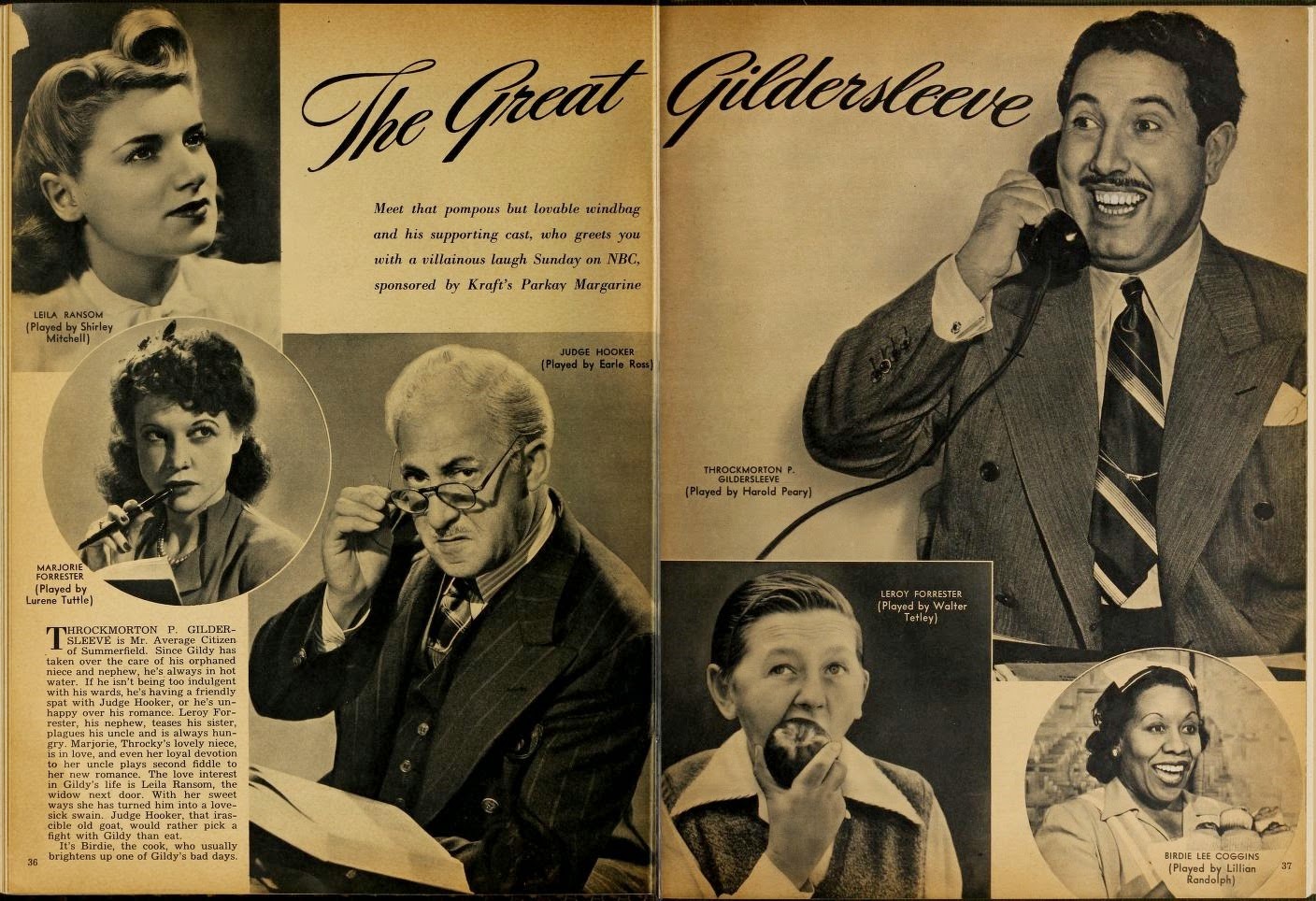
Girded with a part-Scottish, part Brooklyn accent and with the ability to use words to cut as sharp as a razor, Tetley contrasted well against his oafish, probably-Midwestern uncle. Gildersleeve was not the father - just a figurehead and Leroy was not the son, just a facsimile - a nephew (the son of Gildersleeve's sister.) Despite the fact they barely knew each other, Gildy and Leroy had a special relationship from day one in every sense of the word.
At the age of 7, Tetley was a star, bringing in a bundle of money. By age 16, Tetley was a minor superstar radio veteran having already amassed some 2,800 broadcasts. When Tetley got the job as Leroy he was like the cleanup hitter for the New York Yankees as far ability goes. He had been lauded nationwide as a notorious scene-stealer. Whenever he guest starred on a show the cast and audience loved him and the biggest actors and show began asking specifically for him to appear and Tetley made the rounds at both NBC and CBS on a regular basis. And while Tetley played a smart-alecky brat on all the dozens of show in which he appeared, he did it with perfect comedic timing.
Tetley and Gildersleeve both had impeccable timing. This is especially true of Tetley, who was actually quite older than he appeared to be (there's a story out there that says his mother actually had him castrated so that he could play child parts forever and keep bringing in the money.)
Leroy loved to catch his uncle doing anything that wasn't quite appropriate for an elected official to do and would almost always call him out on it, publicly or privately. Leroy's enjoyment of doing this flustered Gildy so badly he would often clamor, "Hmfph oh! Lee-eee-eee-roy...." -- much to the delight of the studio and listening audience.
One time, Leroy and Gildy had planned a trip -- but right before time to go, Gildersleeve's fleeting flame Lila would coerce "Throcky" into taking her shopping because her car was not running.
"I'll give you anything you want, Leroy", Gildy would beg, "If I can just break our date!"
"Anything, Unc?" This would allow Leroy to victimize the gigantic pants off of Gildersleeve, something he did with regularity.
Whenever Gildersleeve would be caught in a faux pas, Leroy would joyfully say, "What a character!" , right to his uncle's face. Somehow, Leroy got away with saying and doing all kinds of little naughty things like this. He was picked up by the police, he got into fights, he harassed the younger neighbor kid. He'd con kids out of their skates and brand-new magic sets. Boil it down and you find Leroy was a Tom Sawyer-type kid but with the wit of no radio character before him (and aside from Arnold Stang and Groucho Marx, none after him.) He was aware of the fun of manipulation and the power of psychology. He was not a bad boy or a delinquent, by any stretch of the imagination. It was just that inside of him was both a conniving con man and a rogue tattletale yet paradoxically, he was also an assailable, breakable, fatherless child.
If Gildy had a plan, Leroy was there to destroy it. Gildersleeve realized soon after moving in with the two kids that Leroy was going to be someone he would have to keep an eye on. Leroy often ran amok and had the audience enjoying it right along with him. Though it was easy for the audience to like Gildersleeve, Leroy made it even more fun to see Gildersleeve fail. This might be because he was big -- no, make that great. The Great Gildersleeve. And there is some sort of Freudian joy in seeing a big man fall. Leroy was the perfect foil (of many) for the pear-shaped Casanova GIldersleeve.

Though the two characters did not have a father and son relationship, it was obvious that the two loved each other. There were no arguments that ended with, "You're not my father! or "You're not my son!" Leroy actually needed the stern hand of Gildy and oddly, Gildy needed to be brought down to earth by the constant vigil of Leroy. Both lived up to each other's needs and this is what made The Great Gildersleeve seem real and fun.
Of course all of that came to an abrupt end when Peary left NBC for CBS. Everyone else seemed to be jumping the NBC ship and Gildy wanted the big money that CBS was handing out, too. It backfired - maybe one of the biggest backfires in show business history as Peary thought the show would go with him. Kraft, the sponsor, had a long relationship with NBC and declined the move. Peary and Tetley were no longer part of the same family anymore.
Each went their different ways and each was successful, albeit, Tetley more so than Peary. But neither found another like each other again. Magic, after all, doesn't last forever.
©Jimbo 2010/2011
Monday, April 11, 2011
Assorted photo dump

 |
| Fibber/Molly |
 |
| Walter Tetley and Harold Peary in the way I imagine them |
 |
| Norman McDonnell and William Conrad |
 |
| Harry von Zell |


Friday, April 8, 2011
Some stars as kids (1935)
 |
| Walter Tetley |
 |
| Bing Crosby |
 |
| Rudy Vallee |
 |
| Art Van Harvey (Vic) |
 |
| Bernadine Flynn (Sade) |
 |
| Charles Correll and Freeman Gosden (Amos 'n' Andy) |
 |
| Bill Idelson (Rush on Vic and Sade) |
 |
| Ozzie Nelson |
 |
| Harriet Hilliard |
Sunday, March 20, 2011

Friday, February 25, 2011
Awesome photos: part two
 |
| Walter Tetly (age 22) |
 |
| Jerry Colonna and Patsy Kelly |
 |
| Uncle Ezra (left) and the Hoosier Hot Shots |
 |
| Bob Burns, Tommy Riggs, Edgar Bergen and Charlie McCarthy, Rudy Vallee and Joe Penner |
 | |
| Costello and Abbott |
 |
| Phil Baker (one of my favorites) |
 |
| Orson Welles about to do a CBS Worksop |
 |
| Amos 'n' Andy |
Wednesday, February 23, 2011
Walter Tetley plays Boomer's nephew on FM&M
There will be an 8 second delay before the file plays:
This is from October 21rd, 1940.
Good day to you, Fish Fry!
This is from October 21rd, 1940.
Good day to you, Fish Fry!
Thursday, February 17, 2011


Sunday, February 13, 2011
Cool, quick trivia
Q: William Waterman was a rising radio star in the 1940's, yet he was told there would be no way he could ever play bit parts on Fibber mcGee and Molly. Why?
A: Because he sounded too much like The Gildersleeve character. (As a matter of fact, he later took Gildersleeve's place on The Great Gildersleeve.)
Q. Without looking it up, how old was Walter Tetley when he began the Gildersleeve show as "Leroy?"
A. Would you believe 27 years old? He was born in 1915.
FACT: The Cliff Arquette story grows stranger and stranger. I just read that on April 13, 1936, Arquette played a character on Fibber McGee and Molly called, "Wallingford Tuttle Gildersleeve."
FACT: Fibber opened the closet 83 out of 128 times during the closet gag on Fibber McGee and Molly.
FACT: The first adult western was Hawk Larabee, starring Elliot Lewis and Barton Yarborough. There are about 10 know surviving shows on the internet.
A: Because he sounded too much like The Gildersleeve character. (As a matter of fact, he later took Gildersleeve's place on The Great Gildersleeve.)
Q. Without looking it up, how old was Walter Tetley when he began the Gildersleeve show as "Leroy?"
A. Would you believe 27 years old? He was born in 1915.
FACT: The Cliff Arquette story grows stranger and stranger. I just read that on April 13, 1936, Arquette played a character on Fibber McGee and Molly called, "Wallingford Tuttle Gildersleeve."
FACT: Fibber opened the closet 83 out of 128 times during the closet gag on Fibber McGee and Molly.
FACT: The first adult western was Hawk Larabee, starring Elliot Lewis and Barton Yarborough. There are about 10 know surviving shows on the internet.
Subscribe to:
Posts (Atom)
